And another post rescued from the drafts.............
At least, that's what number One Son remarked when we spotted this
on the wall of "The Red Lion" in Red Lion Street, London.
My knowledge of Oliver Cromwell is very sketchy - Charles the something and another Charles, an Oak Tree, Roundheads and broad lace collars, No Christmas, Speed Bonny Boat Like a Bird on the Wing, and, my favourite, courtesy of Benjamin Britten and Peter Pears;
https://www.youtube.com/watch?v=VdMJUVhsVnY
Now for some "real" facts, from Wikipedia:
Cromwell is thought to have suffered from malaria and from "stone", a common term for urinary/kidney infections. In 1658 he was struck by a sudden bout of malarial fever, followed directly by illness symptomatic of a urinary or kidney complaint. The Venetian ambassador, who wrote regular dispatches to the Doge of Venice in which he included details of Cromwell's final illness, was suspicious of the rapidity of Cromwell's death.[105] The decline may also have been hastened by the death of one of his daughters, Elizabeth Claypole, in August. He died aged 59 at Whitehall on Friday 3 September 1658, the anniversary of his great victories at Dunbar and Worcester.[106] The most likely cause of Cromwell's death was septicaemia following his urinary infection. He was buried with great ceremony, with an elaborate funeral based on that of James I, at Westminster Abbey,[107] his daughter Elizabeth also being buried there.[108]
This doesn't match up with the plaque on the pub at all! But, reading on, from
https://en.wikipedia.org/wiki/Oliver_Cromwell%27s_head
which is all about Oliver Cromwell's head, we learn that
Cromwell's body, hidden in the wall of the middle aisle of Henry VII Lady Chapel, took effort to exhume because the wood and cloth were difficult to shift. On 28 January 1661, the bodies of Cromwell and Ireton were taken to the Red Lion Inn in Holborn, joined the following day by the body of John Bradshaw, before being taken to Tyburn for execution. On the morning of 30 January 1661, the anniversary of the execution of King Charles I, the shrouded bodies in open coffins were dragged on a sledge through the streets of London to the gallows, where each body was hanged in full public view until around four o'clock that afternoon.[12] After being taken down, Cromwell's head was severed with eight blows, placed on a wooden spike on a 20-foot (6.1 m) pole, and raised above Westminster Hall.
On the whole, back then, if one was to be executed, it is clearly much better to have died first.
By the way, I'm astonished that Winston Churchill was so tactless as to want to name a Royal Naval Warship after a King-Killer:
Cromwell controversy continued into the 20th century. As First Lord of the Admiralty before the First World War, Winston Churchill twice suggested naming a British battleship HMS Oliver Cromwell. The suggestion was vetoed by King George V, not only because of his personal feelings but because he felt, given the anger caused by the erection of the statue outside Parliament, to give such a name to an expensive warship at a time of Irish political unrest was unwise. Churchill was eventually told by the First Sea Lord Admiral Battenberg that the king's decision must be treated as final.[138]
Especially after this had happened some time earlier:
In 1875 a statue of Cromwell by Matthew Noble was erected in Manchester outside the cathedral, a gift to the city by Mrs. Abel Heywood in memory of her first husband.[133][134] It was the first such large-scale statue to be erected in the open in England and was a realistic likeness, based on the painting by Peter Lely and showing Cromwell in battledress with drawn sword and leather body armour. The statue was unpopular with local Conservatives and the large Irish immigrant population. When Queen Victoria was invited to open the new Manchester Town Hall, she is alleged to have consented on condition that the statue of Cromwell be removed. The statue remained, Victoria declined, and the Town Hall was instead opened by the Lord Mayor. During the 1980s the statue was relocated outside Wythenshawe Hall, which had been occupied by Cromwell's troops.[135]
Tuesday, 29 March 2016
Monday, 28 March 2016
30th October 2015 - Winning the Nobel Prize
I discovered this post in drafts! Did I ever post it? If not, here it is!
BB, No1Son and I all received ours in the same afternoon.
This was after an enjoyable couple of hours playing the "Satyrical Home-Made Machines"
which can be found at near Holburn at
And our medals were minted in front of our eyes; individually stamped to order on shiny silver paper.
I also recommend the "Expressive Photo Booth. I won't publish our results here, but am sorely tempted to use them as a seriously tasteless Christmas Card.
Here's where you should be heading as soon as you can;
BB, No1Son and I all received ours in the same afternoon.
This was after an enjoyable couple of hours playing the "Satyrical Home-Made Machines"
which can be found at near Holburn at
I strongly recommend a visit. Entrance is free, but you will want to buy lots and lots of tokens. I suspect part of the cost of the tokens is to pay for all the ones taken away as souvenirs (like this one);
We were awarded the Nobel Prize for our success with the New Hadron Collider.
I also recommend the "Expressive Photo Booth. I won't publish our results here, but am sorely tempted to use them as a seriously tasteless Christmas Card.
Here's where you should be heading as soon as you can;
| http://www.novelty-automation.com/ |
Sunday, 27 March 2016
Easter 2016 - Christus Victor
Someone at church shared this around - it is too good to keep to myself, and anyway, I want to make sure that I hang on to it.
So, all that follows is a copy and paste..... This is the facebook link is all comes from
https://www.facebook.com/photo.php?fbid=10154110049323217&set=a.10150130312383217.297155.601048216&type=3&theater
So, all that follows is a copy and paste..... This is the facebook link is all comes from
https://www.facebook.com/photo.php?fbid=10154110049323217&set=a.10150130312383217.297155.601048216&type=3&theater
THE
WONDERS OF HOLY SATURDAY---A FORGOTTEN THIRD OF THE EASTER STORY
For most
modern-day Protestants, Good Friday and Easter Sunday are of great importance,
with the Saturday in between a sort of meaningless pause. However, for a great
many Christians in the first millennium, Saturday was as important as Friday
and Sunday of Holy Week. Holy Saturday was the ‘Harrowing of Hell.’ ‘Harrowing’
in modern English has the sense of ‘frightening’ but in the Early Middle Ages
it was an agricultural term that referred to turning over soil in preparation
for planting. Think about that, the ‘turning over’ of Hell to make it fruitful!
In Early Medieval thought, throughout the Christian world, it was act two of a
three-stage drama, and in fact it was the dramatic crescendo of Holy Week.
Would you like to learn more about that? The following is a slightly adapted
excerpt from my book “Water from an Ancient Well” published by Anamchara Books.
Jesus’s
followers through the ages have understood that Christ’s work on holy week was
that of atonement (think at-one-ment). As the Apostle Paul said, within decades
of Christ’s death, “God was in Christ reconciling the world to God’s self” (2
Corinthians 5:19). But how was that marvellous work achieved? Through the ages
there have been a variety of explanations.
The
theory of atonement most Protestants hold today is that of “substitution.” It
goes like this: all humans are sinners who deserve punishment, but God the
Father chose to punish his Son in humanity’s place. While common today, this
theory of redemption has only been popular since Archbishop Anselm of
Canterbury promoted it around the year 1100, more than a thousand years after
the birth of Christianity.
Christians in the Early Middle Ages understood Christ’s work differently; their understanding was commonly based on the perspective of the “Christus Victor” model of atonement. The Christus Victor premise was that Jesus’ death was not a legal settlement with God but rather a battle against the forces of darkness. Descending from the cross into the realm of death, Christ stepped into the arena where all of humanity confronts death and the other works of Satan. Like the bravest of knights, he fought with these terrifying enemies and was victorious; forcing them to release humanity from their grip. This theology is based on passages like Colossians 2:15: “And having disarmed the powers and authorities (evil spiritual powers), he made a public spectacle of them, triumphing over them by the cross,” and 1 John 3:8: “The reason the Son of God appeared was to destroy the works of the devil.” Most specifically, 1 Peter chapter 3 tells of how Christ “having been put to death in the flesh, but made alive in the spirit…went and made proclamation to the imprisoned spirits who once were disobedient.”
The film Lord of the Rings: The Two Towers presents a powerful allegory, inspired by Christ’s descent into the lower realms. In the dark caverns of Moria, the wizard Gandalf (a Christ figure in Tolkien’s epic) stands against a fiery demon called the Balrog. As they grapple with each other, they both fall into a chasm, hurtling down into the Earth’s depths, clawing and slashing at one another as they descend. As the wizard and demon plummet into this dark and fiery underworld, Gandalf’s companions flee to safety. They are grief-stricken over Gandalf’s apparent death, but later in the story, he reappears, now dazzling white and possessing even greater powers than before. He has defeated the Balrog and emerged victorious. In the same way, early Christians imagined Christ dying, battling with Satan in the nether realms, and then rising as the victorious hero. This epic battle—the point where humanity’s salvation was actually achieved—occurred in the ‘Harrowing of Hell’ on Holy Saturday.
Christians in the Early Middle Ages not only studied the Christian scriptures but also other Christian writings, and the monks of the ancient Iona monastery included The Acts of Pilate among the treasured documents of their library. In this book, the Harrowing of Hell is recounted in vivid pictures. Satan rushes to hell after Christ’s death on the cross, “fleeing in fear” as Christ pursues him. When Christ reaches hell’s gates, he demands, “Open thy gates that the King of Glory may come in.” The demons refuse him entrance, but then “suddenly Hell did quake, and the gates of death and the locks were broken small, and the bars of iron broken, and fell to the ground, and all things were laid open.” Christ then frees a jubilant crowd of captives. Afterward, “all the saints of God besought the Lord that he would leave the sign of victory—even of the holy cross—in hell, that the wicked ministers thereof might not prevail to keep back any that was accused, whom the Lord absolved. And it was so done, and the Lord set his cross in the midst of hell, which is the sign of victory; and it shall remain there forever” (italics mine).
For the ancient Celts and Saxons, the cross was a symbol of Christ’s heroic and eternal victory over hell and death. They believed if they descended to the very depths of hell, they would find the cross waiting for them, offering them hope and salvation even there. The psalmist wrote, “If I make my bed in hell, behold, you are there” (139:8 KJV), and the Apostle Paul was “convinced that nothing can ever separate us from God’s love. Neither death nor life, neither angels nor demons, neither our fears for today nor our worries about tomorrow—not even the powers of hell can separate us from God’s love” (Romans 8:38 NLT).
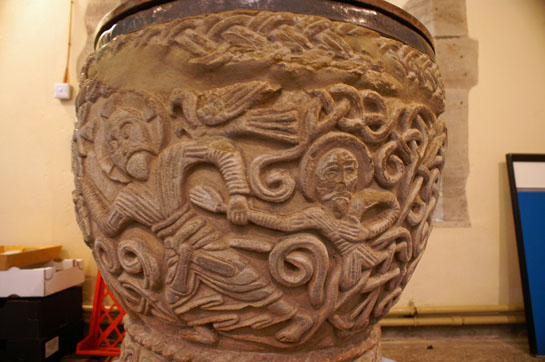
Image:
the Harrowing of Hell—Christ pulls a sinner from death’s realm—portrayed on the
baptismal fount of St. Mary Magdalene Church, Eardisley, Herefordshire,
England.
Easter Sunday - 27th March 2016
It's felt a bit like Christmas Day today.
For a start, I discovered that my Christmas Cactus had surreptitiously produced a couple of flowers on the side facing away from me. How come I never spotted them?
Then the Easter church service felt a lot like a Christmas Service. Apart from it being Hot Cross Buns and a Chocolate Fountain to go with the pre-service coffee, rather than mince pies. A quiz, with Easter eggs for prizes (what is Easter Egg an anagram for?).
The difference being that we also celebrated communion, standing in a large circle, two deep in places, all around the modern square building as bread and wine were brought round.
The weather - cold, rain, hail, blustering wind, sunshine and rainbows;
And a bit traditional celebratory meal with all four of us and my father; roast lamb and all the trimmings, cheese and biscuits, fruit salad (no takers) and finishing off with special seasonal items - Easter Eggs all round. Time for himself to be taken back to his flat for a post-prandiel snooze before his regular Sunday Evening Quiz. Ah yes. The answer is Segregate. That's if you haven't forgotten the question.
An Indoor Easter Egg Hunt prepared by the youngsters for us oldies and a decorated tree;
The rest of the afternoon was "doing your own thing" until - as is traditional at Christmas, New Year and now, Easter, someone turning up with a computer for the menfolk to puzzle over together.
It's now 6pm (7 pm in old money as the clocks went forward last night). Not sure that I will be ready for more food for a while - maybe that fruit salad later on?
Happy Easter! Hmm, just had another couple of chocolate mini-eggs. Not saying I'll give up chocolate yet, just pause in the consumption....
Saturday, 26 March 2016
Saturday 26th March - The Harrowing of Hell
"He descended into Hell"
I don't always look properly at pictures; Dame Catherine, in her blog post here
for more pictures of the font. There is also some interesting information about the carving, the tradition of the Harrowing of Hell, Jarndyce and Jarndyce, Bleak House, and the Hound of the Baskervilles all get a mention.... I think I want to visit Herefordshire again sometime.
I never really understood the pleasures of "church-crawling" in the past, but now it HURTS when we drive past an interesting looking church.
I don't always look properly at pictures; Dame Catherine, in her blog post here
http://www.ibenedictines.org/2014/04/19/the-harrowing-of-hell-holy-saturday-2014/
comments on how tenderly Jesus takes the poor souls by the hand and leads them out of the mouth of Hell, while keeping the Devil at bay in this picture. So I paused to look properly.
Note on the illustration
Harrowing of Hell, illumination about 1190, York; written about 1490, Tempera colours and gold leaf on parchment
Leaf: 11.9 x 17 cm (4 11/16 x 6 11/16 in.)
The J. Paul Getty Museum, Los Angeles, Ms. 101, fol. 82v
Leaf: 11.9 x 17 cm (4 11/16 x 6 11/16 in.)
The J. Paul Getty Museum, Los Angeles, Ms. 101, fol. 82v
Elsewhere, here is Christ pulling a sinner from Hell carved on the baptismal font in St. Mary Magdalene Church, Eardisley, Herefordshire,
England.
![]() |
| http://greatenglishchurches.co.uk/html/eardisley.html |
This Saturday is often a day of bleakness, remembering the horrific events of the first Good Friday (the weather today certainly fits that mood) and for the followers of Christ it must have been grim indeed. But it seems as though Jesus has already left the tomb, and that he is already alive, hard at work releasing the captives from Hell.
It is worth following the link to the website that I snitched this picture from
http://greatenglishchurches.co.uk/html/eardisley.html
Saturday 26th March - The Sliding Block Puzzle
The sacrifices I make to provide a blog post!
I've just brave the cold, grey, dank, blustery HORRIBLE weather outside to take this picture:
which is the state of the back seat of my car. Now that I am back at the computer, sitting next to a hot radiator, I will explain.
The two big black patio planters are my "junk" samba kit (there is a smaller planter inside one of them. The multi-coloured plastic tubes are "boomwhackers" - when you tap them they produce sounds of different pitches. The various bags contain shakers, tambourines, xylophones and sundry assorted instruments. All this stuff lives in the car because - well - there is nowhere else for it. (now, when we get the shed up..... things may change.....)
Anyway, the situation is that the clutch on BB's car is going, so we are not using it in order to preserve what little capability is left for the drive to the garage on Tuesday. So that means we will have to use my car. That's fine, except both offsprings are staying here over Easter, so we will need to fit four into my car. Usually, when we need to empty my car, we just dump everything in the back bedroom - but there is a daughter in there at the moment. Or the little front bedroom - but that is already occupied by the son. Or, if it was just for a day, in the sitting room - but I can't cope with falling over it for a whole Bank Holiday weekend.
Solution - BB is currently, as I type, loading it all into his car, which, let's face it, is little more than a stationary wheeled shed at the moment. On Tuesday we can transfer it all to a vacated bedroom. By the time term starts again, it can all go back in my car.
Perhaps we will need two sheds - a musical shed and a gardening shed? And a third, to be a workshop?
Subscribe to:
Posts (Atom)